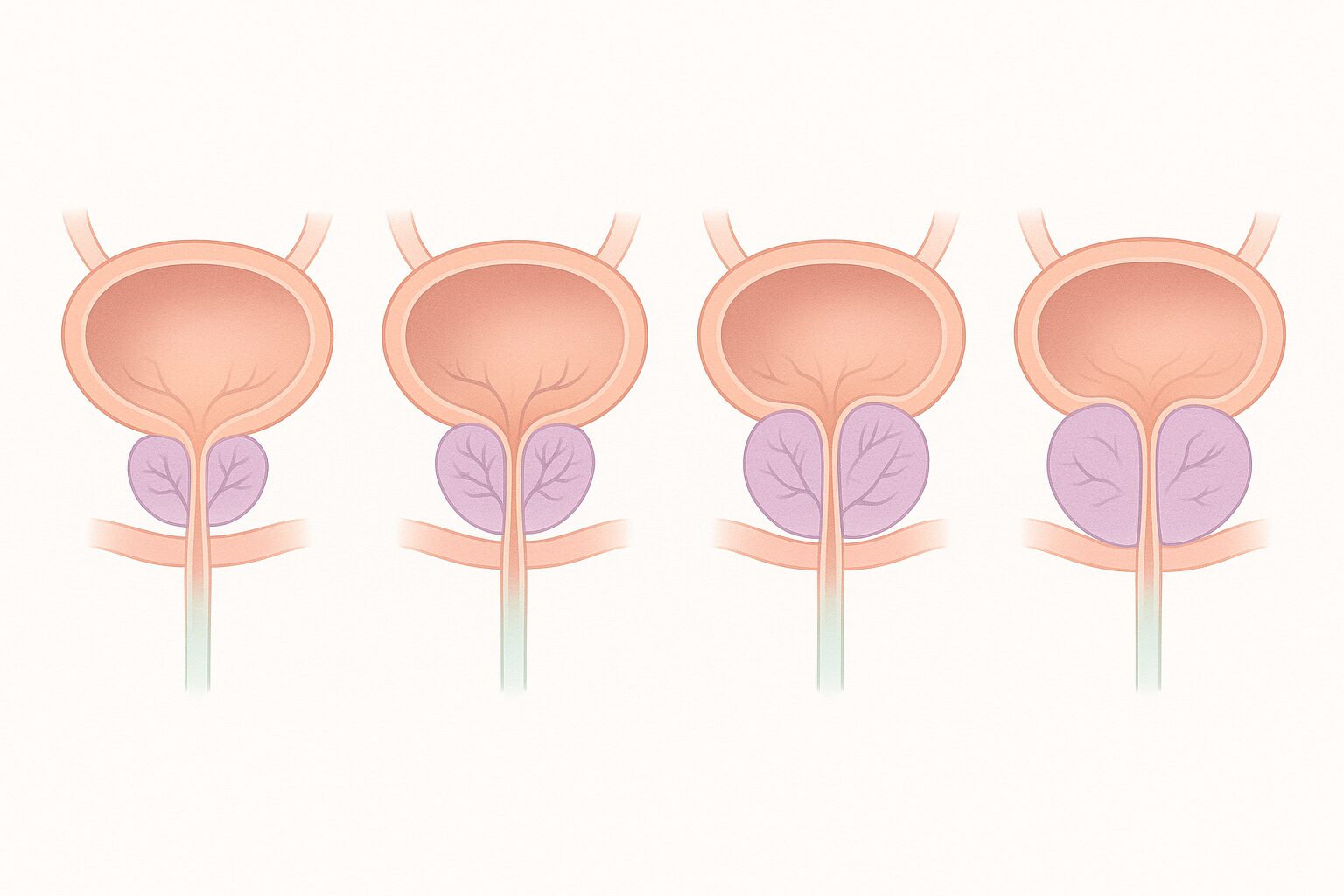
Benign prostatic hyperplasia (BPH) does not arrive overnight. The walnut-sized prostate gland enlarges in slow stages over years, and most men only seek help when symptoms interrupt sleep or daily life. Knowing which stage you are in changes everything: stage 1 and 2 are widely reversible with diet, weight loss, and evidence-based botanicals; stage 3 still responds to combined therapy; stage 4 typically requires medical or surgical intervention. This guide breaks down the four clinical stages of BPH using the International Prostate Symptom Score (IPSS), the tests urologists actually order, and where the reversal window closes.
How urologists actually stage BPH
There is no single universal BPH staging system, but practicing urologists combine three validated metrics: the IPSS questionnaire, peak urinary flow rate (Qmax) from uroflowmetry, and prostate volume from transrectal ultrasound or MRI. The American Urological Association (AUA) and Urology Care Foundation use IPSS as the primary symptom severity tool. Add post-void residual (PVR) volume and PSA, and the stage becomes clinically actionable.
BPH Stage 1 — Mild & fully reversible
Stage 1 typically means IPSS 1-7, Qmax above 15 mL/s, prostate volume 25-35 cc, and PVR under 50 mL. Symptoms are subtle: slightly slower stream, mild hesitancy, one nighttime bathroom trip. Most men dismiss these as normal aging. This is the highest-leverage intervention window — weight loss, Mediterranean-style diet, zinc adequacy, and a structured 12-week natural protocol can return Qmax to baseline.
BPH Stage 2 — Moderate symptoms, intervention window open
IPSS 8-19, Qmax 10-15 mL/s, prostate volume 35-50 cc, PVR 50-100 mL. Now symptoms interrupt life: two to three nighttime trips, weak stream, urgency, incomplete emptying. Cochrane reviews of saw palmetto show measurable IPSS improvement at 320 mg/day standardised extract over 12 weeks. Beta-sitosterol shows the strongest evidence in this stage. Combining lifestyle with botanicals reverses symptoms in roughly 6 out of 10 stage-2 men.
BPH Stage 3 — Severe symptoms, partial reversal
IPSS 20-35, Qmax under 10 mL/s, prostate volume often above 50 cc, PVR above 100 mL. At this stage, alpha-blockers (tamsulosin) and 5-alpha-reductase inhibitors (finasteride, dutasteride) become first-line. Botanicals remain useful adjuncts but cannot substitute. Read when natural is not enough for the medication and minimally invasive procedure decision tree.
BPH Stage 4 — Complications, surgical territory
Acute urinary retention, bladder stones, recurrent UTIs, hydronephrosis, or rising creatinine. Stage 4 is no longer about shrinking the gland — it is about preserving kidney function. TURP (transurethral resection of the prostate), holmium laser enucleation (HoLEP), prostatic urethral lift (UroLift), and Rezum water vapor therapy are the AUA-endorsed options. Natural supplements are not appropriate primary therapy here.
The reversal window — when does it close?
| Stage | IPSS | Qmax (mL/s) | Reversibility | First-line approach |
|---|---|---|---|---|
| 1 — Mild | 1-7 | >15 | High (8-12 wks) | Lifestyle + zinc + diet |
| 2 — Moderate | 8-19 | 10-15 | Moderate (12-16 wks) | Botanicals + lifestyle |
| 3 — Severe | 20-35 | <10 | Partial only | Rx + lifestyle adjunct |
| 4 — Complicated | ≥20 + retention | <5 | Symptomatic only | Surgical / MIST |
Tests to ask your urologist for
- IPSS questionnaire — 7 symptom questions, takes 3 minutes
- Uroflowmetry (Qmax + voided volume + flow curve shape)
- Post-void residual (bladder ultrasound, non-invasive)
- PSA — track trajectory not just absolute number
- Transrectal ultrasound or MRI for prostate volume
- Urinalysis to rule out infection mimicking BPH symptoms
Frequently Asked Questions
Can stage 2 BPH be fully reversed without medication?
Roughly 6 in 10 stage-2 men achieve clinically meaningful IPSS reduction (>4 points) on a 12-16 week protocol combining weight loss, Mediterranean diet, zinc adequacy, and standardised botanicals like saw palmetto 320 mg/day plus beta-sitosterol. Cochrane data supports the symptom improvement; volume changes are smaller.
What IPSS score means I should see a urologist?
Any score above 7, any nighttime frequency above twice, blood in urine, incomplete emptying that persists, or rising PSA. Do not wait for stage 3.
How fast does BPH progress between stages?
On average 1-2 IPSS points per year untreated. Risk factors that accelerate: abdominal obesity, type 2 diabetes, sedentary lifestyle, low vitamin D, and metabolic syndrome.
Does prostate size always match symptoms?
No. Some men with 80cc prostates have minimal symptoms; some with 35cc are miserable. The pattern of smooth muscle tone in the bladder neck matters more than raw volume — which is why alpha-blockers work even when finasteride does not.
Sources & Further Reading
- Urology Care Foundation — BPH overview
- AUA Guideline on Management of BPH
- NIH NIDDK — Prostate Enlargement
- Mayo Clinic — BPH diagnosis & treatment
- Cochrane — Serenoa repens for BPH (review)